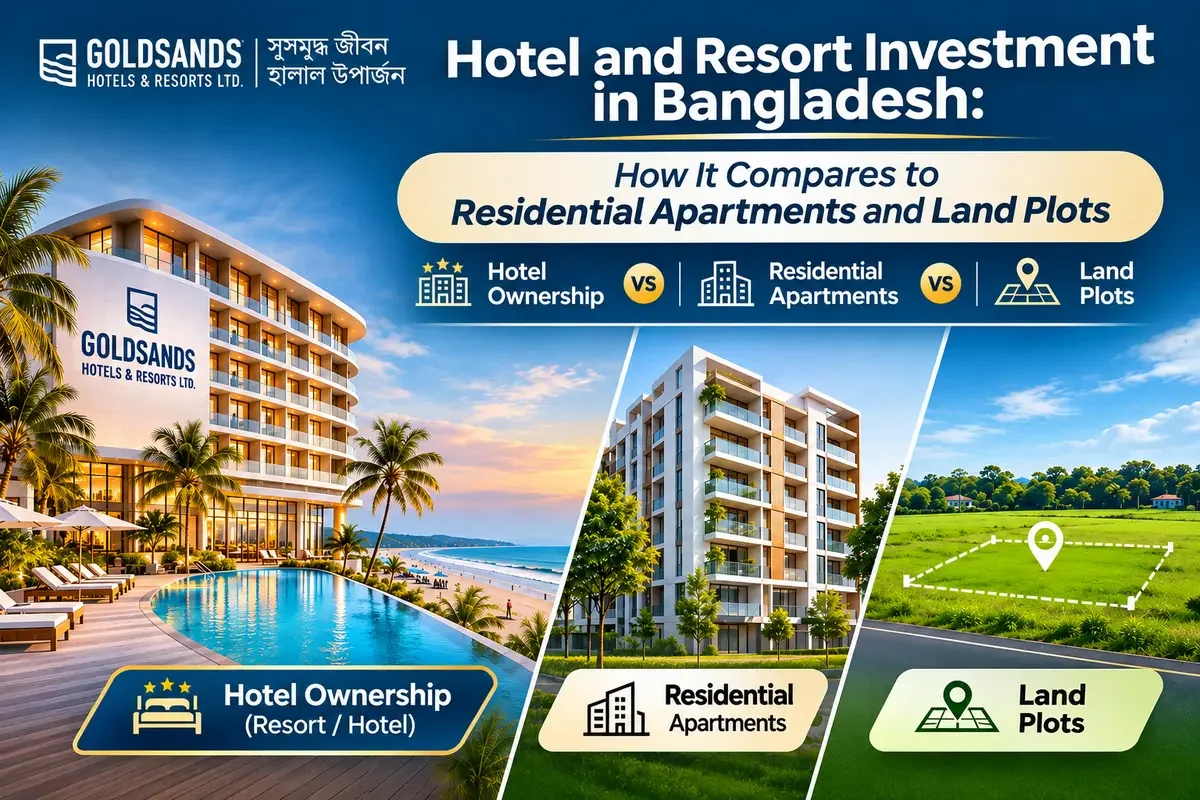
Hotel and Resort Investment in Bangladesh: How It Compares to Residential Apartments and Land Plots
Most people here who want an income-producing asset look at the same two options: a residential apartment to rent out, or a land plot to hold. Both can work. Both also carry problems that rarely come up during the booking conversation. Hotel and resort investment in Bangladesh has become a third route, and it behaves differently enough from the other two that a side-by-side comparison is worth the time.
This is written for two readers in particular. One keeps savings out of interest-bearing accounts and needs an asset's structure to actually hold up, not just carry a halal label. The other already owns a residential apartment or a land plot and has run into the limits of both.
Where residential apartments and land plots start to disappoint
A residential apartment produces rent, which sounds like the simple answer. Then the details arrive. You handle tenants, repairs, service charges, and the months between one tenant leaving and the next arriving. Rent also rises slowly, while the price you paid was set by a market that had already priced in years of future growth. Once service charges and empty months are subtracted, what is left each year is often a smaller share of the purchase price than owners expected when they bought.
A land plot has the opposite problem. Value can climb well, but the asset pays nothing while you wait. Meanwhile you carry mutation and record-keeping work, boundary disputes, and the quiet risk that comes with a plot nobody visits often. Selling takes months and usually means accepting whatever a single interested buyer offers.
And money that sits in neither — in a Fixed Deposit or simply in cash — has its own problem: inflation takes a little of its value every year, whether you notice or not.
Neither a residential apartment nor a land plot is a bad asset. Each simply does one job and ignores the other: a land plot grows without paying, an apartment pays a little without growing much.
How hotel ownership in Bangladesh actually works
Hotel ownership splits a hotel into individually owned suites. You take ownership of one suite, or a share of one, and a professional operator runs the whole building as a single business. You do not deal with guests, staff, or repairs.
What you own
You hold a SAF Kabla Registration in your own name for a defined share of a specific suite, including the land it stands on. That is the part worth checking first in any offer of this kind. A registered deed means you own immovable property. Without one, you hold a claim against a company, which is a different thing entirely and far harder to recover if the company struggles.
Ask a second question too: does the developer own the land outright? Many projects in this sector are built on a landowner's plot under a joint-venture agreement, and disputes between landowner and developer are a common cause of stalled buildings. Every Goldsands project is built on Goldsands' own land, so that risk does not arise.
Goldsands Hotels & Resorts Ltd structures ownership this way across its coastal portfolio:
- Bay Hills, Himchori, Cox's Bazar — a 4-star hotel that is already complete and fully operational
- Bay Sands, Kolatoli, Cox's Bazar — 5-star
- Bay Marina, Inani, Cox's Bazar — 5-star, glass architecture
- Bay Breeze, Kuakata — 5-star
- Kuakata Tourism City — the flagship development on 10.39 acres near Kuakata's Zero Point, with twin 35-storey hotel towers, villas, and a water park
How the income is calculated
Hotel revenue gets split between the owners and the operation. Goldsands applies a 30/70 split: 30% of revenue is distributed to owners, and 70% covers running the hotel — staff, utilities, maintenance, marketing, and management.
The number that matters most in that sentence is not 30. It is occupancy. A suite in a hotel running at 45% occupancy and the same suite at 85% produce very different cheques, and no developer controls the weather, the tourist season, or the economy. Anyone quoting you a fixed monthly figure for a hotel that has not opened yet is quoting a projection. Treat it as one. The ROI calculator exists to let you change the occupancy assumption yourself and see the range, rather than a single flattering number.
The long-term driver behind occupancy is tourism demand. Domestic travel to Cox's Bazar and Kuakata has grown steadily, and the supply of quality hotel rooms in prime beachfront locations is limited by the land itself. That combination supports both income and the value of the asset over time — but it is a trend, not a promise for any given season.
What you pay, and when
Entry works on a deposit-plus-instalment basis rather than a lump sum: roughly 25% down, with the balance spread across 48 monthly instalments. Current projects start from around ৳6 lakh at Bay Marina and Bay Breeze, and ৳8 lakh at Bay Sands. Full pricing by suite type sits on the ownership packages page, and the six-step ownership process covers document verification and registration in order.
The halal question deserves more than a label
Plenty of offers in this market carry the word halal. Fewer are built in a way that survives a careful reading, so it helps to know what you are checking for.
Riba enters an arrangement through a fixed, pre-set return — money promised regardless of whether the underlying business earned anything. That is precisely why a fixed monthly figure should make you more cautious, not less. In a genuine profit-sharing arrangement, the owner shares the business's actual outcome: a strong season pays more, a weak one pays less.
Three things to verify in any offer:
- Is the income tied to performance, or fixed? Income that moves with the hotel's actual results is consistent with profit-sharing. A pre-set rate is not, however the paperwork describes it.
- Is the underlying business halal? A hotel earning a meaningful share of revenue from alcohol compromises the whole structure. Goldsands operates its properties alcohol-free with halal-certified kitchens, which keeps the income clean at the point where it is generated.
- Is there a real asset behind your money? Islamic finance requires ownership of something tangible. The SAF Kabla Registration is what satisfies this, which brings the first check and the last one together.
More detail on the contract structure sits on the Shariah compliance page. Bangladesh Bank also publishes guidance on Islamic banking and finance in the country, which is useful background on the regulatory framing: Bangladesh Bank.
Hotel ownership, residential apartment, or land plot: a direct comparison
Hotel ownership Residential apartment Land plot What you hold SAF Kabla Registration for a suite share, including land Registered deed to a unit Registered deed to a plot Income source Share of hotel revenue Monthly rent None until sale Predictability Varies with occupancy Fairly steady, with vacancy gaps No income to predict Your workload None — operator manages Tenants, repairs, collection Record-keeping, protecting the plot Entry cost From ~৳6 lakh, then instalments Full unit price or bank financing Full plot price Halal structure Works if performance-linked and asset-backed Rent is permissible; interest-based financing is not Permissible, but idle Exit Transfer possible, but a young resale market Established resale market Slow, buyer-dependent Growth driver Tourism demand and beachfront scarcity Area development Area development
| Hotel ownership | Residential apartment | Land plot | |
|---|---|---|---|
| What you hold | SAF Kabla Registration for a suite share, including land | Registered deed to a unit | Registered deed to a plot |
| Income source | Share of hotel revenue | Monthly rent | None until sale |
| Predictability | Varies with occupancy | Fairly steady, with vacancy gaps | No income to predict |
| Your workload | None — operator manages | Tenants, repairs, collection | Record-keeping, protecting the plot |
| Entry cost | From ~৳6 lakh, then instalments | Full unit price or bank financing | Full plot price |
| Halal structure | Works if performance-linked and asset-backed | Rent is permissible; interest-based financing is not | Permissible, but idle |
| Exit | Transfer possible, but a young resale market | Established resale market | Slow, buyer-dependent |
| Growth driver | Tourism demand and beachfront scarcity | Area development | Area development |
The honest reading of that table: hotel ownership wins on effort and on income potential, the land plot wins on having nothing to run day to day, and the residential apartment sits in between with the most developed resale market of the three.
What can go wrong
Any comparison that skips this section is selling rather than explaining.
Occupancy falls short of projections. Tourism responds to politics, weather, and the economy. A weak season reduces distributions, and the profit-share model passes that reduction straight to you. That is the trade-off you accept in exchange for the upside of a strong season.
The project is delivered late. Construction schedules slip in this sector, and income begins only when the hotel opens. Do not rely on renders. Visit the site, and ask to see something the developer has already finished. With Goldsands, that means Bay Hills in Himchori — complete, open, and receiving guests.
Exit is slower than for a residential apartment. Ownership can be transferred, but the resale market for hotel suite shares in Bangladesh is still young, and finding a buyer will not be as quick as selling a residential apartment in Dhaka. Treat this as a long-hold decision. If you may need the capital within two or three years, this is the wrong asset.
Your returns depend on the operator's competence. You cannot replace hotel management the way you can replace a tenant. The developer's delivery record and its operating partner matter more here than in any other property purchase — which is why a hotel already open and running is worth more than any brochure claim.
Who this suits
Hotel and resort investment in Bangladesh fits you if you have capital you can leave in place for several years, you want income without becoming a landlord, and you need the structure to be genuinely riba-free rather than relabelled. It fits particularly well alongside a land plot, since one asset pays while the other appreciates.
Stay with a land plot or a residential apartment if you may need the money back quickly, if you want an asset you can sell to almost anyone on short notice, or if a variable monthly figure would keep you awake. Those are reasonable preferences, and no return projection should talk you out of them.
If you want the narrower version of this comparison, the post on hotel versus apartment investment covers that pairing on its own.
Frequently asked questions
Is hotel and resort investment in Bangladesh halal?
It depends on the structure, not the sector. Performance-linked income, a halal revenue source, and a registered tangible asset together make it compliant. A fixed, pre-set return does not meet that standard.
What is the minimum needed to start?
Current Goldsands projects start from around ৳6 lakh at Bay Marina and Bay Breeze, and ৳8 lakh at Bay Sands, paid as a down payment with the balance over 48 monthly instalments. Pricing varies by project and suite size.
Do I get a legal deed, or just a certificate?
A SAF Kabla Registration in your name, including the land. Ask any developer this question directly, and ask to see a specimen before you pay anything.
Is any Goldsands hotel already operating?
Yes. Bay Hills in Himchori, Cox's Bazar, is complete and fully operational. The other projects are at different stages of construction.
How is my income calculated?
From your share of hotel revenue under the 30/70 split, which means it moves with occupancy rather than arriving as a fixed amount.
Are there benefits beyond income?
Owners receive the Goldsands Reward Card, which gives 30–40% discounts at more than 100 partner establishments.
Can non-resident Bangladeshis take ownership?
Yes. Goldsands maintains offices in Dubai and New York for exactly this. The Bangladesh Investment Development Authority publishes current rules on foreign and NRB investment procedures.
Before you commit to anything
Visit the site — and visit Bay Hills while you are in Cox's Bazar. Read the deed. Move the occupancy assumption down, not up, and decide whether you are comfortable with the number you see at 45%. Then compare that figure against the net rent your money would earn in a residential apartment, after service charges and vacant months.
Run your own numbers on the ROI calculator, then look at what each project offers in the ownership packages. If the structure fits how you want to hold money, Call or WhatsApp 01877-715333 and bring your questions about the contract — those are the ones worth an advisor's time.